


 English
 中文简体
中文简体 русский
Content
- 1 The Short Answer: A Polymer Backbone Plus a Compounding Package
- 2 Natural Rubber: What Comes Out of the Tree
- 3 Synthetic Rubber: What Comes Out of the Refinery
- 4 What Else Goes In: The Compounding Recipe
- 5 From Polymer to Product: Four Processing Steps
- 6 How Composition Shows Up on a Data Sheet
- 7 Reclaimed Rubber: Composition After a Second Life
- 8 Frequently Asked Questions
In a typical tire tread compound, the rubber polymer makes up only about 47 percent of the total weight. The rest arrives at the mixer as carbon black, process oil, zinc oxide, sulfur, accelerators and antidegradants. That single proportion is the fastest way to answer the question of what rubber is made out of, because the material people actually cut, mold and sell is not one substance. It is a polymer plus a carefully weighed package of chemistry.
30-40%Rubber hydrocarbon content of fresh field latex
100 phrThe fixed reference weight every recipe is built on
1.5-2.5 phrSulfur in a conventional cure system
The Short Answer: A Polymer Backbone Plus a Compounding Package
Rubber is made out of a long-chain polymer combined with fillers, oils, curatives and protective chemicals. The polymer itself is either cis-1,4-polyisoprene tapped from the Hevea brasiliensis tree, or a synthetic chain built in a reactor from monomers recovered from petroleum and natural gas. Everything else in the recipe exists to make that chain processable, durable and predictable in service.
Rubber is an elastic polymer network rather than a single substance. Its rubbery behaviour comes from crosslinks that tie long polymer chains to one another; without those crosslinks, the same chains soften and flow when heated.
Isoprene, the five-carbon monomer behind natural rubber, is a small molecule. Polymerisation links thousands of those units head to tail into a chain whose molecular weight can reach several hundred thousand grams per mole. That length is what allows the material to stretch to several times its original length and recover, provided the chains are anchored to each other.
A raw polymer on its own is close to useless on a production line. Unvulcanised natural rubber is tacky in warm weather and brittle in cold weather, and it loses strength rapidly above 60 degrees Celsius. The compounding package fixes those weaknesses, which is why nearly every specification you will ever read describes a compound, not a polymer.
Natural Rubber: What Comes Out of the Tree
Natural rubber is made out of field latex, a milky suspension that is roughly 30 to 40 percent polyisoprene, 55 to 65 percent water, and a small but important fraction of proteins, lipids, sugars and mineral salts. The non-rubber fraction is tiny by weight, yet it drives cure behaviour, odour, ageing and allergy risk.
| Component | Typical share | Why it matters |
| cis-1,4-polyisoprene | 30 to 40 percent | The elastic backbone of the material |
| Water | 55 to 65 percent | Carrier phase, removed during coagulation and drying |
| Proteins | 1 to 2 percent | Stabilise latex in the tree and cause Type I latex allergy in people |
| Lipids and resins | 1 to 2 percent | Act as natural antioxidants and influence curing |
| Carbohydrates | About 1 percent | Feed bacteria, which is why ammonia or another preservative is added |
| Ash and mineral salts | Under 1 percent | Remain as residue and are reported as ash content on the data sheet |
Harvesting starts when a tree is about five to seven years old. A tapper shaves a thin spiral of bark, latex runs into a cup, and the liquid is preserved with ammonia for shipment. At the factory the latex is coagulated with formic acid and then processed into one of three commercial forms: unsmoked sheets, ribbed smoked sheets, or crumb rubber sold under technically specified grades.
Grade names carry composition information. Marks such as SVR 10, SIR 20 or SMR 20 refer to the maximum permitted dirt content in parts per hundred, so a 20-grade rubber is allowed roughly twice the contamination of a 10-grade material.
For a deeper comparison of the two polymer routes, the breakdown of natural latex and synthetic polymers is worth reading alongside the raw material specifications you receive from your supplier.
Synthetic Rubber: What Comes Out of the Refinery
Synthetic rubber is made out of monomers recovered from petroleum and natural gas, then polymerised in a reactor under controlled temperature, pressure and catalyst conditions. Because the monomer ratios can be adjusted within tight windows, the resulting polymer is far more consistent batch to batch than plantation rubber.
| Family | Starting monomers | Standout property | Typical parts |
| SBR | Styrene and butadiene | Wet grip and abrasion resistance | Tire treads, shoe soles |
| BR | Butadiene | Low-temperature flexibility | Sidewalls, belt covers |
| EPDM | Ethylene, propylene and a diene such as ENB | Ozone and weather resistance | Roofing, outdoor mats, hose |
| NBR | Acrylonitrile and butadiene | Oil and fuel resistance | Gaskets, fuel hose, seals |
| CR | Chloroprene | Flame resistance and weather stability | Belts, cable jackets |
| IIR | Isobutylene with a few percent isoprene | Very low air permeability | Inner tubes, curing bladders |
| Silicone | Polydimethylsiloxane | Wide service temperature range | Seals, food-contact parts |
Butyl rubber contains only about 1 to 2 percent isoprene by weight. That tiny fraction of unsaturated units is what allows an otherwise inert chain to be vulcanised at all.
The ISO 1629 naming system groups these materials by the structure of their backbone. Grades with an R suffix, such as NR, SBR, BR, NBR and CR, have unsaturated carbon chains and cure readily with sulfur. Grades with an M suffix, including EPDM and silicone, have saturated chains and normally need peroxide, resin or a similar cure system instead.
What Else Goes In: The Compounding Recipe
Per 100 parts of rubber, a general-purpose compound typically carries 40 to 60 phr carbon black, 5 to 30 phr process oil, 3 to 5 phr zinc oxide, 1 to 2 phr stearic acid, 1.5 to 2.5 phr sulfur, 0.8 to 2 phr accelerator and 1 to 3 phr antidegradant. Those figures are the working range for a conventional sulfur-cured compound, and they shift considerably once heat resistance, oil resistance or low compression set enters the specification.
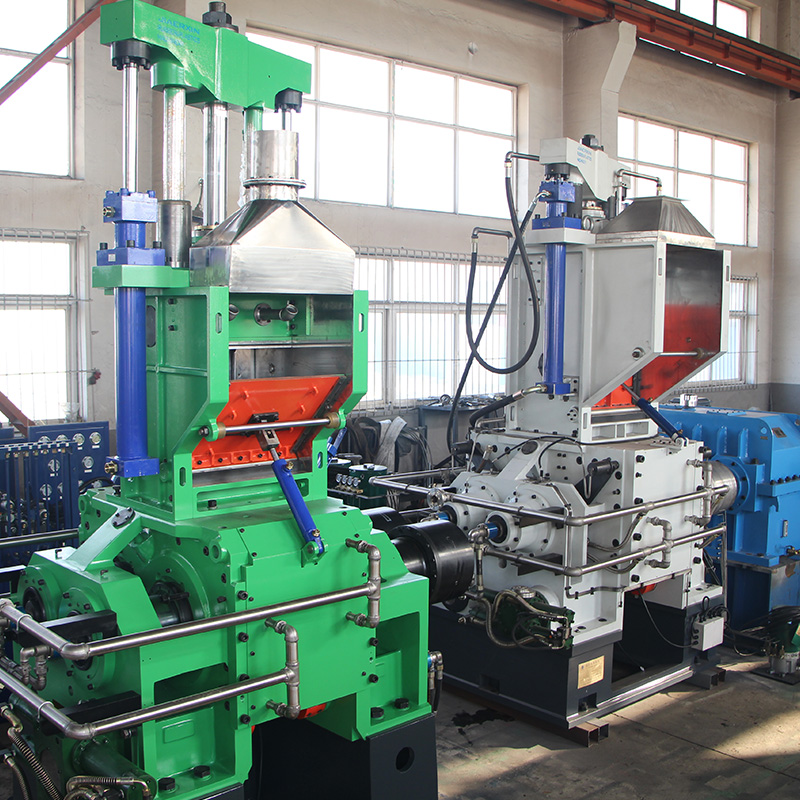 Rubber Banbury Machine for Rubber and Plastic MixingHigh-performance mixer with hydraulic control and optimized rotor for dispersing carbon black, process oil, and additives in rubber compounds.View Product →
Every number in that sentence is measured in phr, which stands for parts per hundred rubber. The reference weight is always 100 parts of polymer, never the finished compound weight, so a recipe can be scaled up or down without recalculating the ratios.
Carbon black is rarely less than 40 phr in a mechanical rubber good. Cut it below that level and tensile strength and tear resistance fall quickly, even though the compound becomes easier to process and cheaper to mix.
The ingredient families fall into five functional groups:
- Fillers, mainly carbon black and precipitated silica, add strength, hardness and abrasion resistance.
- Plasticisers and process oils soften the mix, improve flow and lower mixing temperature.
- Activators such as zinc oxide and stearic acid convert the accelerator into its active form.
- Curatives, sulfur or peroxide, create the crosslinks that make the rubber elastic.
- Antidegradants, including amines, phenols and waxes, slow down oxygen, ozone and heat ageing.
From Polymer to Product: Four Processing Steps
Turning those ingredients into a usable part follows four steps, and composition changes at each one. Weighting errors of a few grams in a 50 kilogram batch are enough to shift hardness by several points on the IRHD scale.
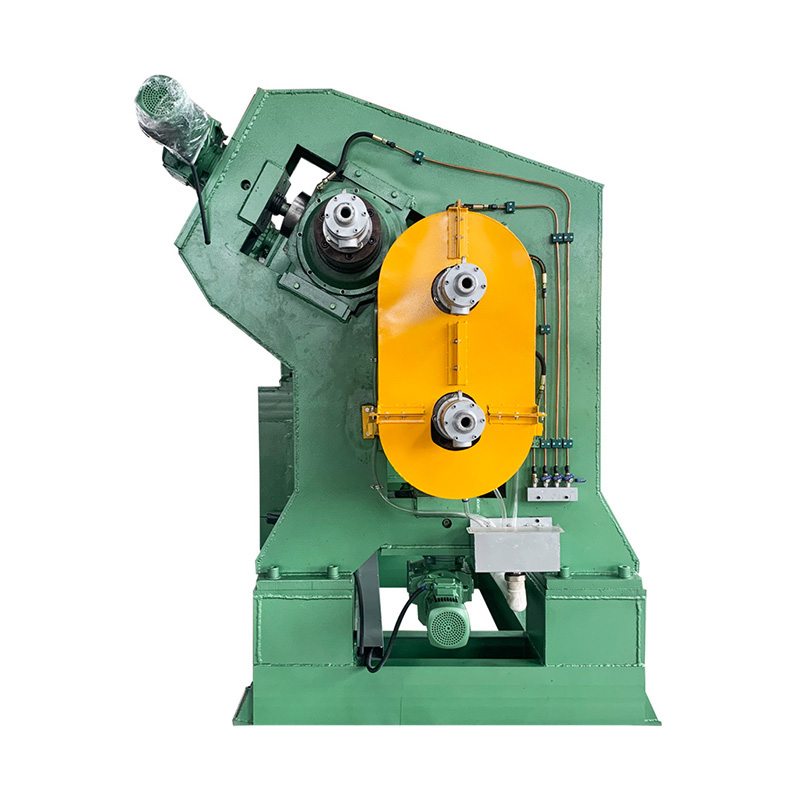 3 Rolls Rubber Calender Machine for Coating and CalenderingThree-roll calender with PLC control and adjustable roll spacing for coating cord, canvas, or calendering engineering tire inner liner sheets.View Product →
Compounding
Ingredients are weighed to the phr recipe and bagged. Polymer bales are cut, warmed and often pre-masticated to bring Mooney viscosity into range before the fillers go in.
Mixing
An internal mixer or open mill folds carbon black and oil into the polymer. Dump temperature is the critical control point, since a mix that discharges too hot will scorch or cure partially in the mixer.
Shaping
Calendering produces sheet of controlled gauge, extrusion forms profiles and hose, and compression or injection molding fills a cavity. The compound is still thermoplastic at this stage and can be reworked.
Vulcanization
Heat triggers the cure system and locks the shape permanently. A thick part may sit in a press for 20 minutes at 150 to 160 degrees Celsius, while a thin extruded profile can be cured continuously.
Sulfur on its own can take hours to cure a heavy section. Accelerators shorten that to minutes, which is why hardly any commercial compound is cured with sulfur alone.
How Composition Shows Up on a Data Sheet
A rubber data sheet reports polymer identity, monomer ratios, contamination limits and processing behaviour, which turns invisible chemistry into numbers you can compare. Reading those numbers against the application is the fastest way to catch a mismatch before the material reaches the line.
- Acrylonitrile content in NBR runs from about 18 percent for low oil resistance up to 42 percent for severe fuel contact.
- Bound styrene in SBR is typically around 23.5 percent in the standard emulsion grade, and higher styrene raises wet grip and heat build-up.
- Ethylene and propylene ratio plus ENB content define how an EPDM cures and how well it tolerates ozone.
- Mooney viscosity ML(1+4) at 100 degrees Celsius usually lands between 40 and 80 for a mixed compound.
- Ash, volatile matter and dirt content set the ceiling on natural rubber grade selection.
Two suppliers can quote the same grade name and deliver different material. Batch-to-batch variation in natural rubber is a plantation reality, while synthetic grades stay inside tight specification windows.
Natural rubber
- Source: latex from Hevea trees
- Very high tensile and tear strength
- Excellent low-temperature flexibility
- Poor oil and fuel resistance
- Price moves with weather and planting cycles
Synthetic rubber
- Source: refinery monomers
- Properties tuned by monomer ratio
- Oil, heat and ozone resistance available
- Consistent from batch to batch
- Price tied to feedstock and energy costs
Where specification matters most, the compound data should be checked against the finished part, not the polymer alone. The same reasoning applies across industrial rubber products, from sheet and matting to hose covers and belt compounds.
Reclaimed Rubber: Composition After a Second Life
Reclaimed rubber is made out of ground scrap, mostly end-of-life tires, that is devulcanized and refined back into a processable sheet. The material still contains rubber hydrocarbon, but it also carries the carbon black, oil, ash and cure residues that were in the original compound.
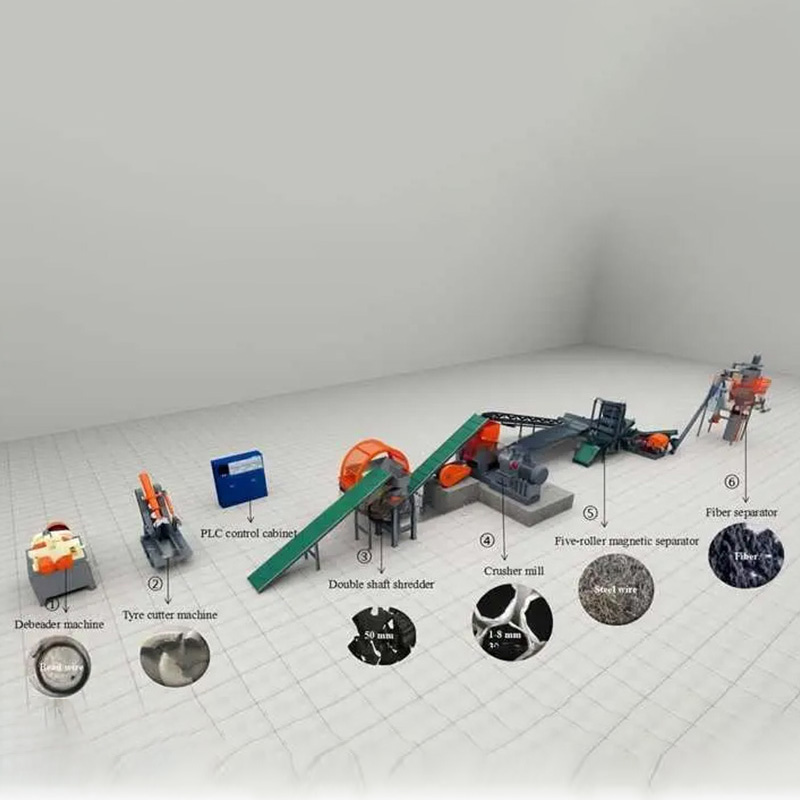 Waste Tire Recycling Machine for Rubber Powder ProductionCrushing, screening, and magnetic separation system that prepares 10 mesh and -40 mesh rubber powder from end-of-life tires.View Product →
The process starts with grinding, then magnetic separation of steel and removal of textile fibre. Devulcanization follows, either thermo-mechanical, chemical or microwave assisted, and refining finally produces a smooth sheet. A typical reclaim contains roughly 40 to 50 percent rubber hydrocarbon, with the balance made up of carbon black and mineral fillers.
Reclaim is normally loaded at 5 to 20 phr in a technical compound. Above that level, tensile strength and compression set degrade noticeably, although cure speed often increases.
Adding reclaim lowers raw material cost and diverts scrap from landfill, which is why it appears regularly in mats, wheel chocks and other non-critical goods. It is a poor fit for dynamic seals or high-temperature applications where consistent compression set matters more than price.
Frequently Asked Questions
Is rubber made from oil?
Partly. Synthetic rubber is made from monomers such as butadiene, styrene and isoprene that come from petroleum and natural gas. Natural rubber is not, since it comes from the latex of the Hevea brasiliensis tree. Most industrial rubber goods use one or the other, and many use both in a single compound.
What is the difference between natural and synthetic rubber at the molecular level?
Natural rubber is almost pure cis-1,4-polyisoprene, a regular chain that crystallises under strain and gives very high strength. Synthetic grades are built from two or more monomers, so the chain carries different side groups along its length. Those side groups are what create oil resistance in NBR or weather resistance in EPDM.
What does phr mean in a rubber recipe?
Phr stands for parts per hundred rubber. Every ingredient is expressed relative to 100 parts of rubber polymer by weight, so a compound with 50 phr carbon black contains half as much black as polymer. It is a ratio system, not a percentage of the finished mix.
Can rubber be made without sulfur?
Yes. EPDM, silicone and many specialty grades are cured with peroxides, phenolic resins or metal oxides instead of sulfur. Sulfur remains the most common curative because it is inexpensive and works well with unsaturated chains such as NR, SBR and NBR.
The composition story ends where the application begins: a compound is only correct when its polymer, filler load and cure system match the heat, oil and flexing the part will actually meet.
 Previous