


 English
 中文简体
中文简体 русский
Content
What Is a Rubber Banbury Machine and How Does It Work?
In a rubber compounding plant, the mixing stage defines final product quality—and the Banbury machine is the closed-chamber workhorse that makes it happen. Unlike a two‑roll open mill, an internal Banbury mixer confines the compound inside a temperature‑controlled chamber, where two specially shaped rotors apply intensive shear to distribute carbon black, oils, and curatives. The result is faster cycle times, less operator exposure to dust, and far more consistent dispersion. For a primer on the core mechanics, our explainer on how a rubber mixer works covers the cycle phases and energy flow in detail.
The Banbury principle relies on a figure‑eight chamber cross‑section and a tangential or intermeshing rotor pair that pulls the batch into the nip zone. High pressure and friction raise the compound temperature, so jacket cooling and ram pressure control become critical for avoiding pre‑vulcanization. Engineers value the Banbury design because it scales reliably from a 3‑liter laboratory bowl to a 120‑liter production configuration, delivering the same dispersion index when process parameters are matched.
Key Types of Rubber Banbury Mixers
Decisions start with rotor geometry. Manufacturers typically offer two families—tangential and intermeshing—and the choice influences everything from filler incorporation speed to clean‑out time. Understanding the trade‑offs ensures you don’t over‑specify a machine and drive up both capital cost and energy consumption for a compound that doesn’t need extreme dispersion. A detailed breakdown of available configurations is available in our guide to types of rubber Banbury machines, but the practical selection logic always returns to the rotor type.
Tangential (Non‑Interlocking) Rotor Design
Tangential rotors run with a deliberate gap between the rotor crests—typically 4 to 8 millimeters depending on chamber size. This geometry creates a rolling bank of compound in the chamber center, making it highly effective at accepting large‑particle fillers like whole‑tire crumb or high‑loading silica.
- Best for high‑filler recipes where you need rapid incorporation without rotor interference.
- Simpler mechanical design means fewer wear components and easier access for cleaning during color or compound changes.
- Typical applications: conveyor belt cover compounds, EPDM roofing membrane batches, and masterbatch with reclaim rubber.
Intermeshing (Interlocking) Rotor Design
Intermeshing rotors maintain a constant, narrow clearance between the two helical profiles, generating a more uniform shear field. Because no material bank sits idle between the rotors, temperature distribution is tighter—often ±3 °C across the batch—and the dispersion of critical ingredients such as zinc oxide and accelerators reaches higher ratings.
- Preferred when downstream part performance—tensile strength, abrasion resistance—is directly tied to micro‑dispersion.
- Slightly higher power draw per kilogram of output, but often yields shorter total mix cycles once friction curves are optimized.
- Common in tire tread, inner liner, and specialty fluoroelastomer compounding.
Critical Selection Parameters for a Banbury Machine
Beyond rotor type, three engineering parameters define whether a Banbury mixer will meet your daily throughput and quality targets. Overlooking any one of them leads to bottlenecks or excessive scrap rates.
Mixing Chamber Volume (Capacity)
Chamber volume dictates your batch weight, not your output. A good rule of thumb: fill factor should be 70–80% of net chamber volume, with specific batch weight calculated from the compound’s density. A 25‑liter chamber, loaded at 75% with a compound of 1.15 g/cm³, yields roughly a 21‑kg batch. Multiply by the realistic number of batches per hour—usually 4 to 6 for full cycles including loading and discharge—and you get daily capacity. For a plant targeting 3 tonnes per day, a pair of 75‑liter mixers often represents the sweet spot, while a 5‑liter model suits compound development labs.
Rotor Speed and Power
Speed determines heat generation. A two‑speed or variable‑frequency drive gives operators the ability to start at low speed for filler incorporation, then ramp up for distributive mixing. Power draw typically falls between 45 kW for a 25‑liter unit and 500 kW for production‑scale 120‑liter machines. Match the installed motor to your hardest‑mixing compound—for NR‑rich truck tire formulations with high carbon black loading, target at least 0.4 kW per liter of net chamber volume as a conservative starting point.
Cooling System Configuration
Temperature control is the primary defence against scorch. Jacket‑style cooling, where water circulates through drilled channels in the chamber and rotor cores, handles up to 80% of heat load. For temperature‑sensitive compounds—such as those using ultra‑accelerators—consider a pressurized water system or a temperature control unit (TCU) that maintains ±1 °C rather than simple tower‑water loops. Spray‑cooled rotors provide an extra margin when a recipe demands fine control of dump temperature below 120 °C.
Comparison with Other Rubber Mixing Equipment
Not every factory needs a Banbury. An open mixing mill can be the right economic choice for very small labs or for warm‑up and sheeting duties after an internal mixer, while a kneader excels with delicate, low‑viscosity pastes. The table below draws a practical line between the three families, based on throughput, energy efficiency, and compound compatibility.
| Equipment | Typical Batch Size | Dispersion Quality | Best Suited For |
|---|---|---|---|
| Banbury Mixer | 20–200 kg | High | High‑volume masterbatch, tire compounds |
| Open Mixing Mill | 10–50 kg (per bank) | Moderate | Warm‑up, sheeting, small color batches |
| Kneader | 5–100 L | Medium‑High | Adhesives, silicone gums, low‑viscosity mixes |
For factories that need to break down natural rubber and simultaneously incorporate large filler portions in a single, dust‑free cycle, the Banbury remains the highest‑throughput option. A detailed look at the alternative open‑mill workflow is available in our rubber open mixing mill guide, which clarifies when open mills make sense alongside an internal mixer.
Step‑by‑Step Selection Process for Your Factory
The jump from general knowledge to a purchase decision is easier with a structured checklist. Work through these five stages with your process engineer and production planner before requesting formal quotes.
- Characterize your compound portfolio. List every recipe you run regularly, noting its Mooney viscosity, filler loading (phr), and any temperature‑sensitive accelerators.
- Calculate required batch weight. Convert your annual tonnage target into a daily batch count, then determine the net chamber volume. Remember to keep the fill factor between 70% and 80%.
- Select rotor type. High‑filler, abrasive compounds generally favor tangential rotors; precision dispersion and low‑temperature mixing push toward intermeshing rotors.
- Confirm utilities and footprint. A 75‑liter drive can draw over 300 A at 380 V. Ensure your transformer and cooling‑water loop can handle the startup load and reject the expected heat.
- Review control system integration. Look for PLC‑based recipe management, real‑time energy monitoring, and the ability to log batch records for traceability.
Once these variables are defined, you can narrow the field to specific chamber volumes and drive ratings. At that stage, comparing actual our rubber Banbury machine models against your checklist will show which build specification delivers the fastest payback without over‑engineering.
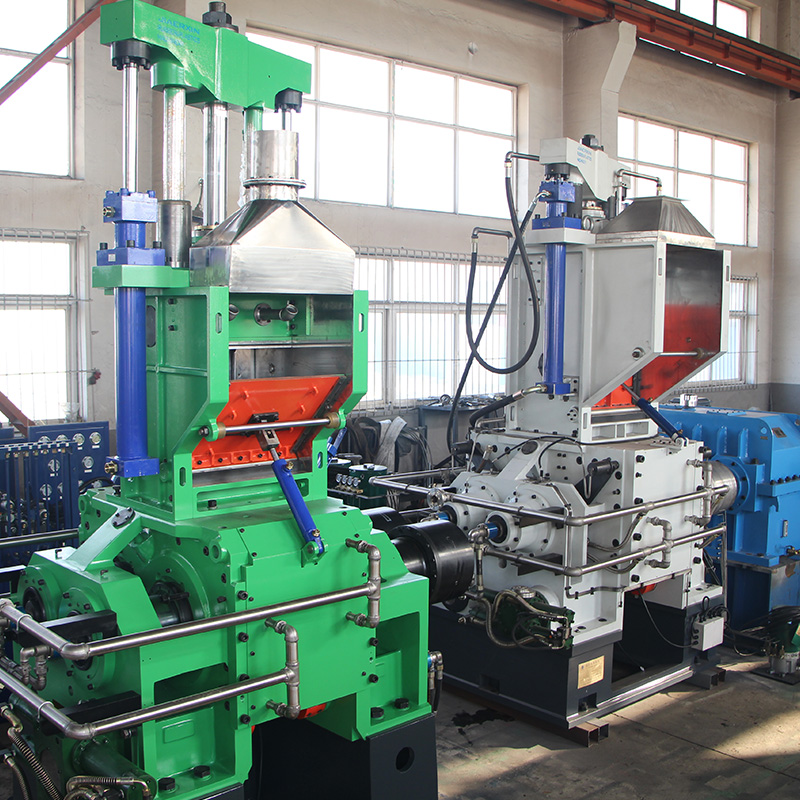 Rubber Banbury Machine Suppliers, Company - Anhui Sincere Machinery Co., Ltd.As top Rubber Banbury Machine Suppliers and Company in China, Sincere Machinery offer Custom Rubber Banbury Machine for sale, In the fiel...View Product →
Maintenance Tips to Extend Banbury Machine Life
A well‑maintained Banbury mixer regularly exceeds 15 years of service, but the difference between longevity and expensive rebuilds lies in four routine practices.
- Rotor seal inspection. Polymer leakage past the dust‑seal rings leads to compound contamination and bearing damage. Check lubrication flow and seal condition every 500 operating hours.
- Discharge door alignment. A misaligned drop door creates a shearing edge on each cycle, eventually wearing the saddle to a point where chamber volume changes. Set the clearance with feeler gauges during scheduled downtime and log the readings.
- Bearing temperature monitoring. Rotor bearings should run below 80 °C in continuous duty. Install infrared probes or embedded thermocouples and interlock alarms that stop the drive if a bearing exceeds 90 °C.
- Lubrication consistency. High‑temperature lithium‑complex grease for the main bearings, and a separate synthetic oil mist for the seal rings, are the standard choices. Standardize on one grease specification plant‑wide to avoid incompatibility.
 Previous